


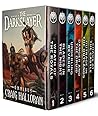
The Darkslayer Monster-Sized Collection by Craig Halloran
Genre: Epic Fantasy / Sword & Sorcery
Rating: ⭐⭐⭐ (3 stars — massive, action-driven, but struggles with repetition and depth over time)
Tagline:
Brutal battles and endless war—but a journey that overstays its welcome.
16 Book Boxset: https://amzn.to/4coX7UQ
Individual Books: https://amzn.to/4v8XNF5
⚔️💀 Tropes & Story Elements
• Epic Fantasy
• Sword & Sorcery
• Dark Fantasy
• Antihero Protagonist
• Found Family
• War & Survival
• Monster Hunting
• Political Intrigue
• Multi-POV Adventure
• Long-Form Saga
This series leans heavily into classic sword-and-sorcery DNA, pulling inspiration from older fantasy traditions where action, survival, and brute force take center stage over introspection. The antihero narrative drives much of the tone, while the found family elements attempt to ground the story emotionally—though not always successfully.
The inclusion of political intrigue and multi-POV storytelling adds scope, but the execution prioritizes momentum over nuance, making these elements feel more functional than deeply layered.
⚠️ Content & Trigger Warnings
• Graphic violence and gore
• War and battle brutality
• Death and loss
• Dark themes throughout
• Moral ambiguity
Violence is not just present—it’s constant.
This is a world where conflict is the default state, and the brutality is described in a way that reinforces the harshness of the setting. There’s very little emotional distance from the violence, which works for immersion but can become exhausting over such a long stretch of story.
The moral ambiguity is also consistent—there are no clear heroes or villains in the traditional sense. Instead, characters operate in shades of survival and self-interest, which adds realism but limits emotional attachment for some readers.
🩸 Full Thoughts
The Darkslayer Monster-Sized Collection is not just a series—it’s a full-scale endurance read. Spanning sixteen books and over a million words, it demands a level of commitment that mirrors the intensity of its world.
From the beginning, the tone is clear: this is a story rooted in brutality, survival, and constant conflict. There is very little softness here—no extended moments of peace, no long stretches of reflection. Instead, the narrative pushes forward with an almost relentless urgency, as if stopping would mean losing momentum entirely.
At its best, this creates an addictive reading experience. You fall into the rhythm of battle, consequence, escalation. The stakes are always high, and the world never feels safe.
But over time, that same intensity becomes overwhelming.
Without enough contrast—without quieter moments to ground the story emotionally—the experience begins to blur. The series becomes less about individual events and more about sustained chaos. And while that works in shorter bursts, across sixteen books it can feel like emotional and narrative fatigue begins to set in.
This is a series that thrives on scale and persistence—but struggles with balance.
⚔️ Scale, Action & Relentless Momentum
The scale of this series is one of its most impressive achievements.
Conflicts don’t just escalate—they compound. What begins as localized danger grows into widespread war, layered with political corruption, supernatural threats, and shifting alliances. Every book introduces new dangers, new enemies, and new complications, creating a sense that the world is constantly on the brink of collapse.
The action reflects that scale.
Battles are frequent, often brutal, and rarely predictable in outcome. There’s a raw, almost chaotic energy to the fight sequences that reinforces the idea that survival is never guaranteed.
However, the pacing rarely shifts.
There’s little distinction between:
• A major battle
• A minor skirmish
• A turning point in the war
Because everything is delivered at the same intensity level, the story loses a sense of hierarchy. Key moments don’t always feel bigger than the rest—they just feel like part of the ongoing storm.
In shorter series, this kind of pacing creates excitement.
Here, it creates saturation.
🖤 Venir — The Core of the Chaos
Venir is the embodiment of this world.
He is not a character designed for emotional relatability—he’s a character designed for impact. His identity is built on violence, survival, and the curse that defines him. He doesn’t question his role; he exists within it.
That makes him compelling in a very specific way.
He feels consistent. Grounded in the tone of the story. A constant in a world that is otherwise shifting and unstable.
But that consistency comes at a cost.
Over the course of sixteen books, Venir’s emotional and psychological growth is limited. He reacts, he fights, he survives—but he doesn’t significantly evolve. His internal world remains largely unchanged, even as the external world around him escalates.
For readers who enjoy archetypal antiheroes, this works.
For readers looking for transformation, it can feel like something is missing.
Because the story changes.
The world changes.
But Venir largely stays the same.
🌍 Worldbuilding — Wide, But Not Always Deep
The world of Bish is expansive in every sense.
There are multiple regions, political factions, power structures, and supernatural elements all interacting at once. The presence of underlings, royal corruption, and ancient threats gives the world a strong foundation for conflict.
On a surface level, it’s immersive.
You understand:
• The dangers
• The power dynamics
• The stakes
But the depth doesn’t always match the breadth.
The story often prioritizes movement over exploration. We move through the world quickly—battle to battle, city to city—without always stopping long enough to fully absorb the cultural, emotional, or historical weight of those places.
As a result, the world feels active—but not always fully lived-in.
It’s a stage for conflict more than a space for immersion.
🔄 Repetition & Structural Fatigue
This is where the series struggles the most—and where the length becomes a challenge rather than a strength.
The narrative structure follows a recognizable cycle:
• Conflict arises
• Characters respond with violence
• Alliances shift
• New threat emerges
• Repeat
Individually, this structure is effective.
Repeated sixteen times, it becomes predictable.
The issue isn’t that the events are boring—it’s that they begin to feel interchangeable. The uniqueness of each moment gets lost in the repetition of the overall pattern.
This creates a kind of reading fatigue where:
• Major plot points lose their impact
• Emotional beats don’t land as strongly
• The story feels longer than it needs to be
The series doesn’t lack content—it lacks variation.
👥 Character Ensemble — Ambitious but Uneven
The large cast is one of the series’ most ambitious elements.
There are multiple characters with their own arcs, motivations, and roles in the broader conflict. This should add richness to the story—and at times, it does.
Certain characters stand out, bringing new perspectives and emotional layers to the narrative.
But the execution is uneven.
Because the story is so focused on action and forward momentum, not every character gets the development they need. Some arcs feel incomplete, while others feel overshadowed by more dominant storylines.
The frequent POV shifts also contribute to this imbalance.
Instead of deepening emotional investment, they sometimes dilute it—pulling the reader away just as a connection begins to form.
The result is a cast that feels large and active… but not always deeply memorable.
⚖️ Why It Lands at 3 Stars
This is a series that clearly succeeds in delivering on its core promise—but struggles with longevity.
It excels in:
✔ Consistent action
✔ Expansive scope
✔ Classic dark fantasy tone
But falls short in:
• Emotional progression
• Narrative variation
• Character depth across the full series
The biggest issue isn’t quality—it’s sustainability.
What works in the early books becomes harder to maintain across sixteen installments. The lack of evolution in structure, pacing, and character arcs makes the experience feel repetitive over time.
This isn’t a bad series.
It’s a series that needed more balance to match its ambition.
🖤 Final Thoughts
The Darkslayer Monster-Sized Collection is a bold, unapologetic commitment to action-driven fantasy.
It knows exactly what it wants to be—and it never strays from that identity.
For the right reader, that consistency is a strength. This is a series you can sink into for endless battles, dark magic, and antihero-driven chaos.
But for others, that same consistency becomes limitation.
Without enough variation in pacing, emotional depth, or character evolution, the experience begins to feel repetitive—especially when consumed all at once.
This is not a series meant to be rushed.
It’s one best experienced slowly, in pieces, where its strengths can shine without its repetition becoming overwhelming.
Because while the world is massive…
…staying immersed in it for that long is a challenge of its own.

No comments:
Post a Comment